
When you feel anxious, speaking God's promises of peace aloud can steady your heart and turn your attention back to Him. These declarations are not a cure or a test of your faith, and they work best alongside good support, including professional help when you need it.
Anxiety is common. Many parents in our community carry worry about money, health, children and the future. If that is you, you are not alone, and you are not failing. This article offers gentle declarations, practical steps and a reminder that help is available.
Anxiety is not a lack of faith
Some Christians feel guilty for feeling anxious. They wonder if it means they do not trust God enough. Please hear this: feeling anxious does not make you a bad Christian.
The Bible is honest about distress. Elijah was so overwhelmed that he asked God to take his life, and God responded with rest, food and a gentle whisper (see 1 Kings 19). Jesus Himself was "troubled and deeply distressed" in the garden before the cross (Mark 14:33). David wrote many psalms from places of fear.
God's response to our fear is compassion. "The LORD is near to those who have a broken heart" (Psalm 34:18, NKJV).
What God says about peace
Scripture gives us many promises about peace. Here are a few to hold on to.
- "Peace I leave with you, My peace I give to you; not as the world gives do I give to you. Let not your heart be troubled, neither let it be afraid" (John 14:27).
- "Be anxious for nothing, but in everything by prayer and supplication, with thanksgiving, let your requests be made known to God; and the peace of God, which surpasses all understanding, will guard your hearts and minds through Christ Jesus" (Philippians 4:6-7).
- "You will keep him in perfect peace, Whose mind is stayed on You, Because he trusts in You" (Isaiah 26:3).
- "casting all your care upon Him, for He cares for you" (1 Peter 5:7).
Notice that Philippians 4 does not say "just stop worrying." It invites us to bring everything to God in prayer. Peace is something He gives as we come to Him.
How declarations can help
When anxiety rises, our thoughts often speed up and spiral. Speaking a short, true sentence slowly can help in a few ways:
- It gently turns your attention from the problem to the God who is with you.
- It gives your mind something steady to hold.
- Speaking slowly can help you slow your breathing.
- It reminds you of what is true when your feelings are loud.
Declarations do not make every feeling disappear. But they can be one helpful part of how you care for your heart. For more background, read What Are Biblical Declarations?
Declarations for peace
Choose one or two that speak to you. Say them slowly. Breathe in, then speak the words as you breathe out.
When worry starts
- God is with me right now. (Hebrews 13:5)
- I cast my cares on God, because He cares for me. (1 Peter 5:7)
- Jesus gives me His peace. My heart does not need to be troubled. (John 14:27)
- God has not given me a spirit of fear, but of power, love and a sound mind. (2 Timothy 1:7)
- I do not have to carry tomorrow today. (Matthew 6:34)
When your mind races at night
- I will lie down in peace and sleep, for the Lord keeps me safe. (Psalm 4:8)
- I lay down and slept. I woke again, for the Lord sustained me. (Psalm 3:5)
- God's peace guards my heart and my mind in Christ Jesus. (Philippians 4:7)
When everything feels like too much
- The Lord is near to the broken-hearted. He is near to me. (Psalm 34:18)
- God is my refuge and strength, a very present help in trouble. (Psalm 46:1)
- Jesus invites me to come to Him and rest. (Matthew 11:28)
For your children
- When I am scared, I will trust in God. (Psalm 56:3)
- God is with me and He is bigger than my worries. (Isaiah 41:10)
- Jesus loves me and keeps me safe. (Romans 8:39)
When you need more help
Sometimes anxiety becomes heavy and ongoing. It may affect your sleep, your work, your eating or your relationships. That is a sign to get extra support, and seeking help is a wise and faithful choice.
- See your GP. Your doctor can talk with you about what is happening and may refer you to a psychologist under a Mental Health Treatment Plan.
- Talk to someone you trust. Share what you are feeling with your spouse, a friend or a pastor.
- Reach out to us. Our pastors and prayer team would be glad to pray with you and help you find support. You can contact the church office at any time.
- Crisis support. If you are in crisis or thinking about harming yourself, call Lifeline on 13 11 14 any time, day or night. In an emergency, call 000.
Prayer and professional care work well together. God often brings healing and peace through doctors, counsellors and caring friends.
Try this week
- Choose one declaration from the list and write it on a card or your phone lock screen.
- Practise a breath prayer. Breathe in slowly and pray, "Jesus, You are with me." Breathe out and pray, "I give You this worry." Repeat for one minute.
- Write it down. Each evening, write down what is worrying you. Then write one verse beside it and pray over the list.
- Make a peace corner for kids. Pick a comfy spot with a Bible verse card, a soft toy and a children's Bible for calm-down moments.
- Book the appointment. If anxiety has been building for a while, book that GP appointment this week.
A prayer for peace
Father, You know everything I am feeling. Thank You that You are near and that You care for me. I bring You my worries now. I give You the things I cannot control. Jesus, thank You for Your peace, which is not like the world's peace. Holy Spirit, guard my heart and mind. Lead me to the help I need, and let me rest in Your love tonight. In Jesus' name, amen.
Come and visit Rhythm
At Rhythm Church Aura, you do not have to have it all together. We are a family of real people learning to trust God in real life. Join us any Sunday at 9:30am at the Nirimba State Primary School hall, 100 Park Avenue, Nirimba. There is space for you here, and we would love to welcome you.
Scripture quotations taken from the New King James Version®. Copyright © 1982 by Thomas Nelson. Used by permission. All rights reserved.
Common questions
Is anxiety a sin or a sign of weak faith?
No. Anxiety is a common human experience, and many faithful people in the Bible felt deep distress. God meets us with compassion, not condemnation.
Can declarations replace counselling or medication?
No. Declarations can be a helpful spiritual practice, but they are not a substitute for professional care. Talking to your GP or a psychologist is a wise and faithful step.
How can I help my anxious child with Scripture?
Choose one short, comforting verse, such as 'Whenever I am afraid, I will trust in You' (Psalm 56:3). Say it together calmly, keep listening to their feelings, and seek professional support if the worry is ongoing.
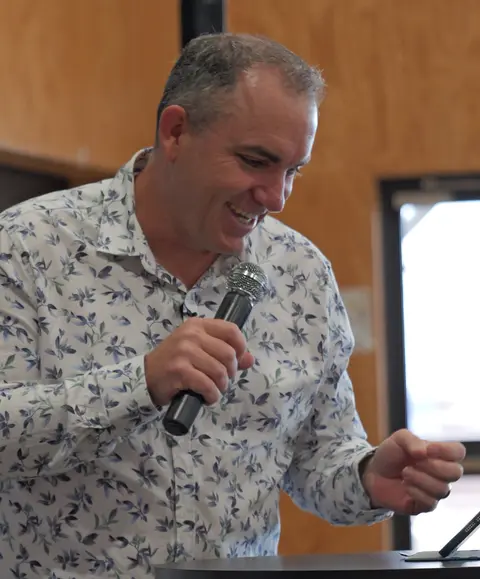
Murray planted Rhythm Church in 2019 and leads it with his wife Kathy. He is a credentialed Australian Christian Churches pastor with a Master of Leadership from Alphacrucis University and more than 25 years in pastoral care, community development and missions.