
A biblical declaration is speaking aloud what God has already said in Scripture, as an act of faith and agreement with Him. It is not a magic formula or a way to control God, but a simple way to fill your mind and heart with His truth.
You may have heard people talk about "declaring" or "confessing" God's promises. Some find the idea exciting. Others feel unsure. This article explains what declarations are, what they are not, and how to start using them with wisdom.
Where declarations come from in Scripture
The Bible shows that our words matter. Jesus said, "For out of the abundance of the heart his mouth speaks" (Luke 6:45, NKJV). Proverbs 18:21 says, "Death and life are in the power of the tongue."
God's people have always spoken His truth aloud. The psalms are full of it. "The LORD is my shepherd; I shall not want" (Psalm 23:1) is a declaration of trust. The prophet Joel wrote, "Let the weak say, 'I am strong'" (Joel 3:10).
In the New Testament, Paul writes, "since we have the same spirit of faith, according to what is written, 'I believed and therefore I spoke,' we also believe and therefore speak" (2 Corinthians 4:13). Hebrews 10:23 encourages us: "Let us hold fast the confession of our hope without wavering, for He who promised is faithful."
Notice where the confidence rests. It is not in the speaker. It is in the God who promised.
What declarations are
Declarations are:
- Agreement with God. We say what He has already said about Himself, about Jesus and about us.
- A way to renew the mind. Hearing truth in our own voice helps it settle in our hearts. See Renewing Your Mind for more.
- An act of worship and trust. Speaking God's promises turns our attention to His goodness.
- A reminder in hard moments. When fear or discouragement speaks loudly, God's Word gives us something true to say.
What declarations are not
It is just as important to know what declarations are not.
- Not a formula. Words are not a key that forces God to act. He is a loving Father, not a machine.
- Not a guarantee of a particular outcome. We trust God's character and His promises. We do not get to decide exactly how or when He answers.
- Not denial. You do not need to pretend things are fine. The psalms are honest about pain. You can say, "This is hard," and also say, "God is with me."
- Not a replacement for wisdom. Declarations sit alongside prayer, good advice, medical care and practical action. They do not replace them.
- Not a measure of your faith. If something you prayed for has not happened, it does not mean you said the wrong words or did not believe enough.
How to write a good declaration
You can use declarations others have written, or you can write your own. Here is a simple process.
1. Start with a verse
Choose a verse that speaks to your situation. Read the verses around it so you understand what it means in context.
2. Put it in the first person
Turn the truth into a short sentence you can say about yourself or your family. For example, Ephesians 1:6 says God "made us accepted in the Beloved." Your declaration could be: "I am accepted in Jesus."
3. Focus on what is true in Christ
The best declarations agree with what God has already done or clearly promised. "God is with me" (Hebrews 13:5) is firm ground. "I will get that job by Friday" is not something Scripture promises.
4. Keep it short and clear
Short declarations are easier to remember and easier for children to say.
Some examples
| Scripture | Declaration |
|---|---|
| 2 Corinthians 5:17 | I am a new creation in Christ. |
| Philippians 4:19 | My God will supply all my need. |
| 2 Timothy 1:7 | God has given me power, love and a sound mind. |
| Isaiah 54:13 | My children will be taught by the Lord. |
| Psalm 118:24 | This is the day the Lord has made. I will rejoice in it. |
How to use declarations day to day
- In the morning. Read two or three declarations aloud before the day gets busy.
- With your family. Say them together at breakfast or in the car. Our Daily Declarations for Families list is a great starting point.
- In hard moments. Keep one or two on your phone for when worry or frustration rises.
- Over time. The power is not in saying them once. It is in letting God's truth become familiar and loved.
A note on feelings
You may not feel what you are saying at first. That is okay. Declarations are not about pretending to feel something. They are about choosing to agree with God while your feelings catch up. Many people find that, over weeks and months, truth that once felt distant begins to feel like home.
Try this week
- Choose one verse that speaks to something you are facing.
- Write one declaration from it, using the steps above.
- Say it aloud every morning and every night for seven days.
- Notice what changes. Jot down any shift in your thoughts, peace or perspective.
- Read further. Our teaching paper Declarations: The Power of Our Words explores this theme in more depth.
- Get the family guide. Download Declarations for Your Family, our free printable guide with lists for mornings, school, bedtime and more.
A declaration to start with
God's Word is true, and He is faithful to what He has said. I am His child, loved and accepted in Jesus. I choose to agree with His Word today. My trust is not in my words but in Him. Every promise of God is "Yes" in Christ (2 Corinthians 1:20), and I rest in His goodness.
Come and visit Rhythm
At Rhythm Church Aura, we love to speak God's Word with faith and with warmth. Join us any Sunday at 9:30am at the Nirimba State Primary School hall, 100 Park Avenue, Nirimba. Come early for a coffee and a chat. We would be glad to welcome you this Sunday.
Scripture quotations taken from the New King James Version®. Copyright © 1982 by Thomas Nelson. Used by permission. All rights reserved.
Common questions
Are declarations biblical?
Yes. Scripture often shows God's people speaking His truth aloud, and 2 Corinthians 4:13 says, 'I believed and therefore I spoke.' Declarations are a way of agreeing with what God has already said.
Are declarations the same as positive thinking?
No. Positive thinking is based on our own ideas, while biblical declarations are anchored in Scripture and in who God is. The focus is trust in God, not the power of our words on their own.
What if I make declarations and nothing changes?
Declarations are not a formula, and they do not control outcomes. God is faithful even when things do not change as we hoped, and an unanswered request never means you said it wrong or lacked faith.
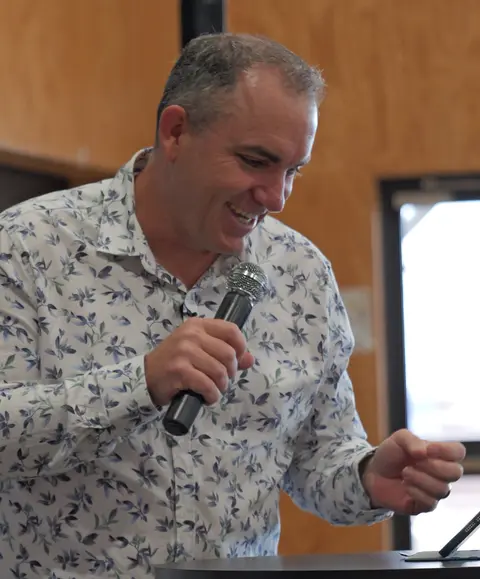
Murray planted Rhythm Church in 2019 and leads it with his wife Kathy. He is a credentialed Australian Christian Churches pastor with a Master of Leadership from Alphacrucis University and more than 25 years in pastoral care, community development and missions.